Strategy from the work up

Everyone is selling you AI. Nobody can tell you what it should do in your organization.

Every week brings a new agent, a new copilot, a new platform, a new promise. Every one of them starts with the tool and asks where it fits. None of them starts with the only thing that decides whether it fits: the work your organization actually does, act by act, and who should be doing each part of it.

NOW OS starts there. It maps your work down to the single action, tells you for every one whether a machine, a person, or both should do it and why, and puts that answer in front of your leaders to decide on the record. The result is the thing every AI strategy is missing: a map of the work you are about to change.

A real map of hiring and onboarding a new employee: 196 steps in 8 stages, each shown as a tile. An AI agent could do 123 of them and 73 need a person. On Day One, 18 of 25 steps need a person.
A real map NOW OS built from a short description of hiring and onboarding. Every tile is one step.

The noise

The market has a thousand answers. It skipped the question.

You have been told AI will take thirty percent of the work. You have been told agents will run whole departments. You have been told to start with a pilot, then told pilots don’t scale. You have sat through demos where the product was impressive and the fit was a mystery, and you have been handed business cases where every number traced back to a vendor’s assumption.

None of this is a technology problem. It is a visibility problem. Nobody selling to you knows what your work is, because nobody has ever drawn it, including you. So every recommendation you have received was a guess about an organization the guesser had never seen.

NOW OS ends the guessing. It is the first thing to do before you buy anything else, and the thing that tells you what everything else should be doing.

Thirty percent of what? On the left, an illustrative org chart under the claim that AI will take thirty percent of the work. On the right, hiring and onboarding mapped step by step: 196 steps. An AI agent could do 123, and 73 need a person: 29 formal approvals, 17 physical tasks software can't do, 13 steps that need information only a person has, 7 required by law or policy and 7 judgment calls.
Same organization, two pictures. One is a guess. The other is the work itself, with the reason each step needs a person.

What is at stake

You are about to make the biggest decisions about how your organization works in a generation.

In the next two years you will decide which work moves to machines, which stays with people, how your teams are shaped around that, what you tell your workforce, and what you tell your board and your regulators. These are strategy decisions, operating-model decisions, transformation decisions. Every one of them is a decision about work.

With NOW OS, you make them on a complete, current map of that work: every act named, owned, costed and scored, with a recommendation and its reasoning attached. Without it, you make them on org charts, job descriptions and vendor slides, which is to say you make them blind.

Why now

This is already happening in your building. The only question is whether anyone can see it.

AI is already doing work in your organization. Someone approved some of it. Some of it arrived inside software you already pay for. Right now, if your board asked which decisions AI is making and who signed for each one, the honest answer is that nobody knows, and the list cannot be pulled together because it was never kept.

Meanwhile the organizations that see their work first are redesigning it first. They are moving faster, spending on the right things and walking into board meetings with evidence instead of hope. Every month you plan without the map is a month of decisions you will have to unmake later.

From map to strategy

The map is not the deliverable. The decisions are.

Once your work is visible at the level of the individual act, the questions leaders have argued about for years become questions with answers.

Swipe to follow the work →

A swimlane of one real task, Day One: hand over laptop and badge. Seven steps across three lanes: a person greets the new hire, an access and credentials agent verifies their identity, the person hands over the laptop and then the badge, the agent activates the badge, a person has the new hire sign the equipment acknowledgment form, and a decision-recording agent records the laptop serial number and badge number. The work changes hands five times.
One task from the same map, drawn as a swimlane: who does each step, and every place the work changes hands. Map one of your own processes and the free download includes a swimlane of it.
Strategy

Where AI creates real value in your organization, and where it doesn’t, shown task by task instead of asserted in a deck.

Operating model

Who should do what, redesigned on purpose. See what happens to a department when forty actions move to a machine, which approvals protect something and which only slow things down, and where the hand-offs actually break.

Transformation

A sequence of changes you can plan, fund and track against the work itself, not a string of pilots that never learn from each other.

Decision making

Every allocation recommended with its reasoning, decided by a named person, and kept in a tamper-evident record your auditors and your board can read.

That is the difference between an AI program and an AI strategy.

Winners and losers

There will be winners and losers. The gap opens one decision at a time, and it does not close.

Every organization runs the same loop: see what is happening, understand it, decide, act. The ones that run it faster, on better information, win. That has always been true. What has changed is that AI makes the loop dramatically faster, but only for organizations that can see their own work.

Everyone else will make the biggest decisions of the decade on guesses: which work to hand to machines, which roles to reshape, where to spend. They will be wrong more often, find out later, and pay twice, once for the mistake and again to unwind it, while their competitors are already on the next cycle.

The advantage compounds, and so does the disadvantage. The organization that sees its work redesigns it, measures what changed and redesigns again, and every cycle makes the next one faster and cheaper. The one that can’t see its work falls further behind with every cycle, until it is not behind anymore. It is out: its costs are structurally higher, its best people have left for places that use them better, and its board is asking how a competitor did in one year what it could not do in five.

NOW OS runs the loop continuously, on the work itself. It notices when a process drifts from its design, tells you what the drift means, puts the choice in front of the right person, records the decision and starts the next look from what actually happened.

There is no neutral position. Waiting is a decision to fall behind.

Five questions

Five questions your board will ask. Can you answer them today?

Ask these in your next leadership meeting and watch the room. Nobody will bluff, because everyone will recognize the same problem at once: the answers are not in any system, any report or any deck, because the work they are about has never been drawn.

  1. “Your AI plan will automate thirty percent of the work. Thirty percent of what?”There is no denominator. An org chart maps authority; job descriptions map intent. Nobody has an inventory of the work itself.
  2. “Pick any task. Show me the evidence it belongs to a person, a machine, or both.”Allocation is decided by hierarchy, habit, or whichever vendor demoed last. Nobody has ever scored a task.
  3. “Which decisions is AI making in your organization right now — and who signed for each one?”Agents are already running. The list was never recorded, so it cannot be pulled together.
  4. “What does one unit of that work cost by hand, versus by machine — and how do you know?”Salaries and FTE counts exist. Cost at the level where work happens does not — so every AI ROI figure is a guess dressed as a number.
  5. “What work must stay human — and where is that list?”Everyone has an automation list. Nobody has a defended human-only list with the reasoning attached.

All five collapse to one admission: we can't see our work at the level where these questions live. And all five are answered by one act — decompose the work to atomic actions, score each on evidence, and have a named person sign each allocation. NOW OS does exactly that.

The four modes

Not “automate or don’t.” Four clear answers for every act of work.

For every action, NOW OS asks two questions everyone else blurs together: could a machine do this, and what would it cost if the machine got it wrong. Every recommendation arrives with its reasoning. Your people accept it, change it or refuse it, and the record keeps their name, the date and the why. Nothing ever promotes itself to autonomy.

AutomateThe machine runs it end to end, because a named person approved it.
AugmentThe machine does the work, and a named owner reviews it before it counts.
AssistYour people do the work, and the machine makes them faster and better prepared.
Human-OnlyA person does it. Held to the same rules as the other three, which is why the answer is defensible.

Use cases

One method. Every kind of work.

A deal, a shift schedule, a wire payment, a marketing campaign, a staffing plan. Different work, different endings — the same frame every time: each step named, each performer visible, and the moments where a named human must decide, shown as exactly that. Select any card, or just watch.

Automate — AI runs it Augment — AI executes, a named human reviews Assist — a human works, AI helps Human-Only — a person decides. Full stop.

Trust you control

You decide how much room a machine gets. You can widen it or pull it back in one move.

The level of confidence at which work may run without a person watching is a setting you own, per kind of work and per level of consequence. As a machine proves itself on a task, you give it more room. If it ever stumbles, you narrow it instantly, and the record shows exactly what changed and who changed it.

Autonomy in your organization is granted and governed the way authority is granted to a person, never slipped in through a software update.

Your people

Your workforce deserves the truth. The map is the truth.

Everyone has heard “AI will augment, not replace” and learned to hear it as a decision made somewhere else. NOW OS replaces the slogan with evidence.

When the work is visible act by act, two things appear together: the repetitive work a machine should take off people’s plates, and the work only a person can be accountable for, which is far more than anyone expects. On our reference deployment, 74,581 actions came back Human-Only, recommended by the same rules that recommended automation elsewhere.

You decide what to do with that, in the open, with the people whose work it is and with your own HR and legal judgment attached. Nobody is blindsided, because in NOW OS every decision about work is visible before it is made.

We watch the work. We never watch the worker. The map comes from your systems of record: tickets, approvals, documents, status changes. Never from anyone’s keystrokes, camera, voice or mood, and never used to rate or blame an individual.

Rehearse the future

Coming to this site next: Scenario Studio. Test the change before you make it.

Once your work is a model, you can change the model before you change the organization. Move a set of actions to a machine and watch what happens to cycle time, cost, approvals and risk. Remove an approval and see what it was protecting. Put three versions of a department side by side before a single role changes.

Walk into the board meeting with the strategy you tested, not the one you hoped for.

Proof, not promise

Not a pilot. Not a demo. A governed process running end to end, today.

Beta R, the first NOW OS release, runs a complete security-exception process for a major U.S. public university system, from intake to decision to audit, on a work model mapped to the individual action. If we can see a university’s work at this depth, we can see yours.

669,064individual actions in one process's Task Atlas
88.9%of actions recommended for autonomous execution — under rules the institution configured
74,581recommended Human-Only — scored by the same rules as the rest
447policies read and grounded — 1,856 pages
18 / ~130agent families / role-specialized agents
~12Bfacts in the full digital-twin knowledge graph

Live platform values, bound to the running system. See the worked case →

See it

This is the real product, not a mockup.

Every screenshot below is the running interface, with the reference customer's name blurred out — customer instances ship under your own name and identity, or NOW OS's. The same product ships as an always-on evaluation instance — every surface clickable, both roles, zero integration risk.

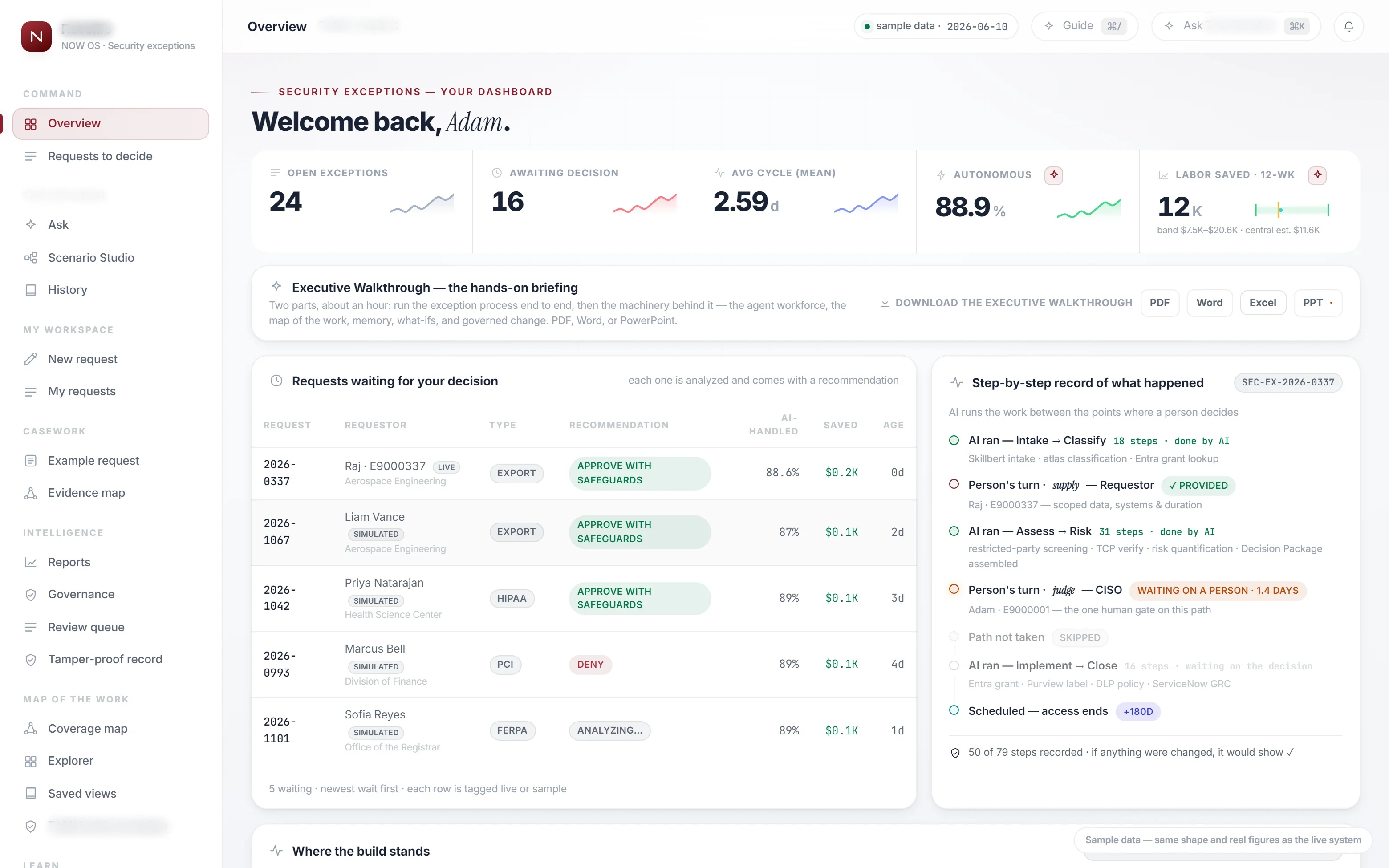
The approver's dashboard

Open exceptions, decisions waiting, cycle time, autonomy rate, and labor saved — with every request analyzed and arriving with a recommendation, not a blank form.

Overview
The approver's overview dashboard

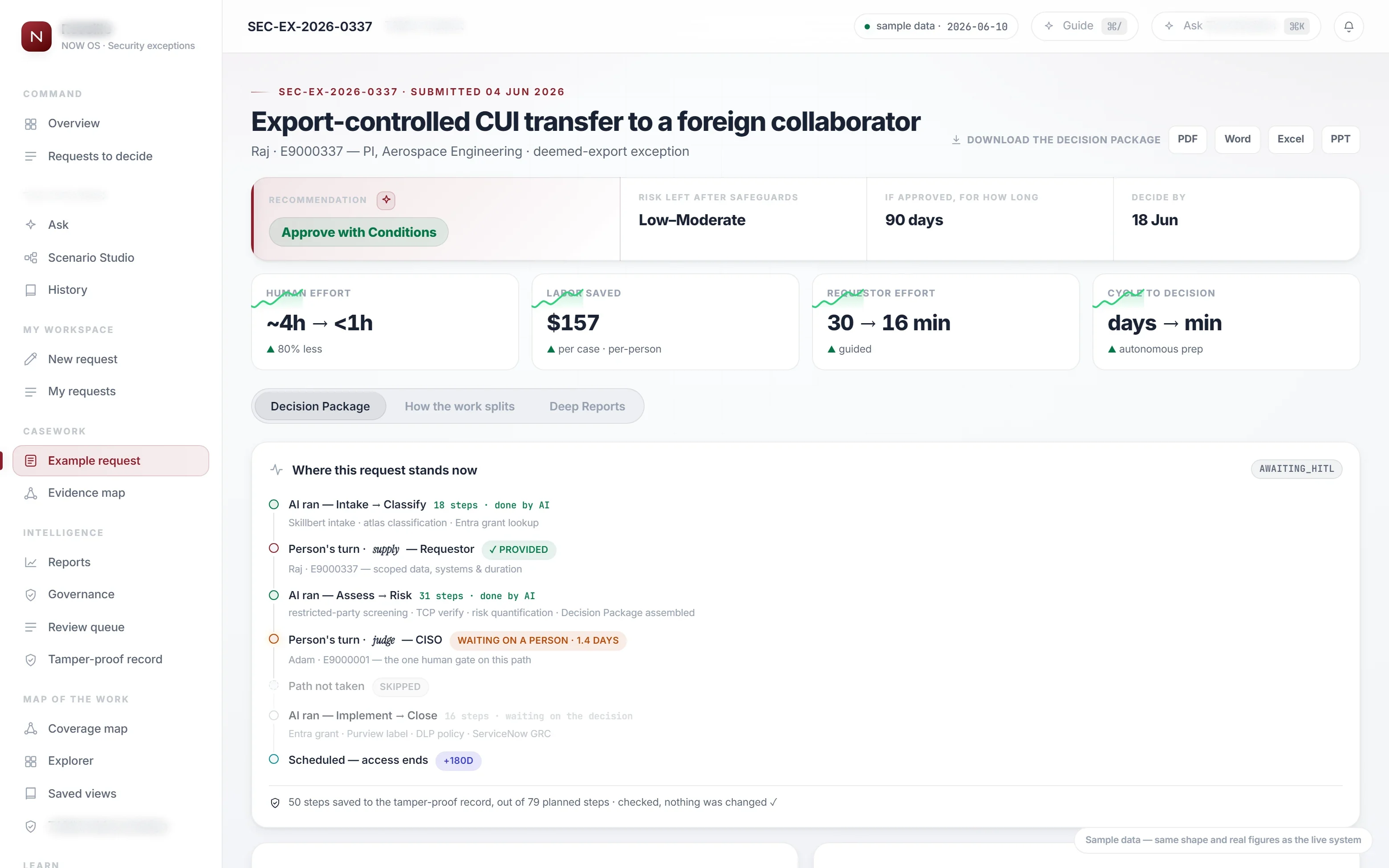
A decision, fully assembled

NOW OS runs intake, classification, and risk assessment — dozens of individual actions — then stops at the one human gate that matters. The approver sees the recommendation, the residual risk, the cost math, and the step-by-step record of exactly what AI did and where a person decided.

See the full worked case →

A worked request
A worked security-exception request with recommendation and step record

The product family

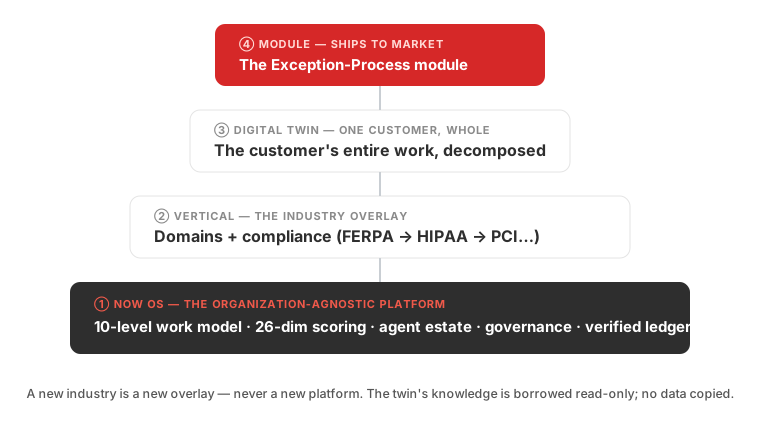
One agnostic core. Many products.

The platform knows nothing about any one customer or industry. A vertical is an overlay; a customer is a mapping — never the foundation. That's what makes the platform reusable across industries.

The four-layer product family: platform, vertical, digital twin, module
1
NOW OSThe platform

The organization-agnostic platform core: 10-level work decomposition, configurable scoring tuned to your own rules, the governance envelope, the agent estate, the governed data lane, the verified ledger.

2
Verticale.g. Higher-Ed

Scopes the operational domains and regulatory frameworks for an industry — FERPA and Title IX for higher education; HIPAA and Joint Commission for healthcare. A new industry is a new overlay, not a new platform.

3
Digital TwinThe whole customer

One customer's entire work, decomposed to atomic actions across every operational domain, connected to their people, policies, and systems in a reasoning knowledge graph.

4
Modulee.g. Beta R

One process, productized: narrow, polished, go-to-market. Beta R — the Exception-Process module — is the first, in beta today. It borrows the twin's knowledge read-only, with full provenance.

Governance

NOW OS recommends. Your people decide — on the record.

Governance in NOW OS is structural, not optional — it cannot be switched off, and it cannot be satisfied by a disclaimer.

Nothing auto-promotes

Everything the agents discover or recommend is filed as a candidate. A named human on the customer's Strategic Advisory Board approves, denies, or defers — every time.

A verified ledger

Every governance decision and execution event lands in a tamper-evident, hash-chained audit log — and the chain is re-verified on every read, not stamped once and trusted forever.

Enforced floors

Restricted work — FERPA, HIPAA, PCI, export-control — carries enforced control floors, so it can never be silently over-automated. Non-compliant work is refused at ingest, fail-closed.

Services

Delivered as a partnership, not a license key.

Four service lines wrap the platform — from decomposing your work, to standing up your twin, to running it with you and training your people.

01

Consulting

Atomic-task decomposition, AAA analysis, workforce-transformation strategy.

02

Implementation

Standing up a customer Digital Twin: data integration, agent wiring, real-system connections.

03

Managed Service

Running the platform as an ongoing operation, with governance support.

04

Training & Enablement

NOW OS University: curriculum, exams, and stackable certifications for your people.

The antidote to tool sprawl

Every tool you own has an opinion about your work. NOW OS is the only one that knows what your work is.

Process-mining tools map a process. Agent platforms run agents. Copilots help inside one application. Each is sold as the answer, and each fragments your organization a little more, because none of them share a picture of the whole.

NOW OS is that picture. Keep the tools you have. We will show you what each one is actually doing and what it should be doing, before you buy the next one.

Start now

Every week without the map is another decision made blind.

If you are setting an AI strategy, redesigning your operating model, leading a transformation or answering to a board about what AI is doing in your organization, the first step is the same: see the work. We can show you your own in a single working session.